
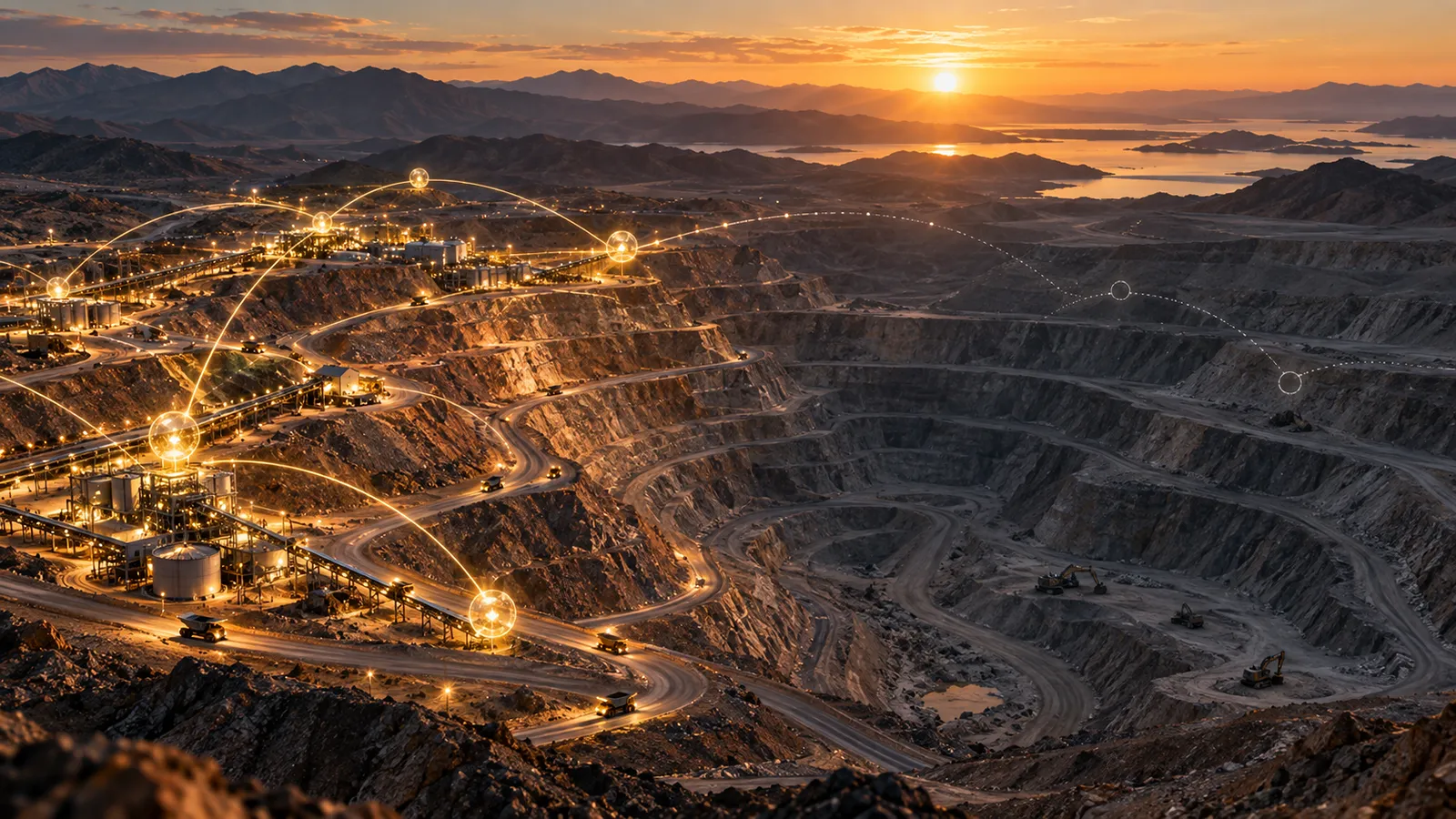
Mining needs capital long before it generates revenue
Building a mine is capital intensive.
Before commercial production begins, developers may spend years funding exploration, drilling, technical studies, permitting, engineering and construction.
At each stage, more capital is required — but project risk remains high and operating cash flow may still be years away.
That creates one of the mining sector’s central financing challenges: the companies responsible for developing tomorrow’s mineral supply often need significant capital before their assets can generate revenue.
Industry research consistently highlights the difficulty junior mining companies face in raising sufficient capital to advance projects. Because junior explorers and developers typically generate little or no operating cash flow, they depend heavily on external capital throughout the development cycle. The Mining Association of Canada
Why traditional funding can become difficult
Mining companies generally have several financing options, including equity, debt, strategic investors, offtake agreements and royalties.
But not every option is equally available at every stage.
Equity
Issuing shares can provide flexible capital, but raising during weak market conditions or at an early development stage can significantly dilute existing shareholders.
Debt
Conventional project debt may become more accessible as a project approaches production and future cash flows become easier to forecast. Earlier-stage developers may find borrowing more difficult or expensive.
Strategic capital
Large miners, commodity traders and strategic investors can provide valuable funding, but transactions may involve project-level rights, control provisions or commercial commitments.
This leaves many developers searching for additional forms of capital that sit between conventional equity and debt.
The scale of the challenge extends beyond individual projects
The funding challenge is growing alongside global demand for new mineral supply.
Copper, lithium, nickel, rare earths and other commodities are required across energy systems, transport, infrastructure, electronics and manufacturing.
Developing that supply requires sustained investment across exploration, mine development and production capacity.
The result is not simply a shortage of capital in one part of the mining cycle. It is a broader mismatch between the scale of capital required and the financing channels available to individual projects.
Note for Monark: I would verify the source behind the A$84B figure before publishing it prominently. I could not find a reliable public source supporting that exact number from the live page or current search results. Your current page contains no source for it. Monark Digital
If A$84B comes from an internal report or client-supplied source, add the source directly beneath the statistic.
Where royalty financing fits
A mining royalty provides capital in exchange for an agreed interest linked to future project revenue or production.
Unlike issuing additional shares, royalty financing does not necessarily require the company to give up equity ownership.
And unlike conventional debt, a royalty does not operate like a traditional loan with principal and interest repayments.
That makes royalties a useful component of the mining capital stack, particularly where an operator wants to fund a project milestone without relying entirely on another equity raise.
The trade-off is straightforward: the operator receives capital today in exchange for sharing a defined portion of future project economics.
The traditional royalty market has its own constraint
Royalty financing is established, but access to the market has historically been concentrated.
Large transactions often favour established projects and larger counterparties capable of deploying significant capital.
That can leave smaller developers caught between two markets:
they may be too early or too small for conventional institutional royalty financing, while repeated equity raises become increasingly dilutive.
This is the part of the market Monark aims to address.
Fractionalisation changes how capital can be assembled
Instead of relying on a single investor to fund an entire royalty transaction, a royalty interest can be divided into smaller digital units and made available to multiple eligible investors.
The underlying asset remains the royalty agreement.
The digital infrastructure changes how participation can be organised.
Fractionalisation has also been explored in institutional digital-asset research. The RBA’s Project Acacia noted that fractionalisation could expand access to new types of investors and potentially reduce issuer dependence on a small number of institutional capital providers. Reserve Bank of Australia
For miners, this creates the possibility of accessing a broader capital pool.
For investors, it can provide access to an asset class that has traditionally been difficult to participate in directly.
Closing the gap requires more than one solution
Digital royalties will not replace equity markets, banks or institutional mining finance.
Nor should they.
Large-scale resource development will continue to require multiple sources of capital.
But improving access to royalty financing can add another tool to the funding mix — particularly for credible junior and mid-tier projects advancing through key development milestones.
The mining funding challenge is ultimately a capital-access problem.
Expanding the infrastructure connecting projects and investors is one way to start addressing it.