
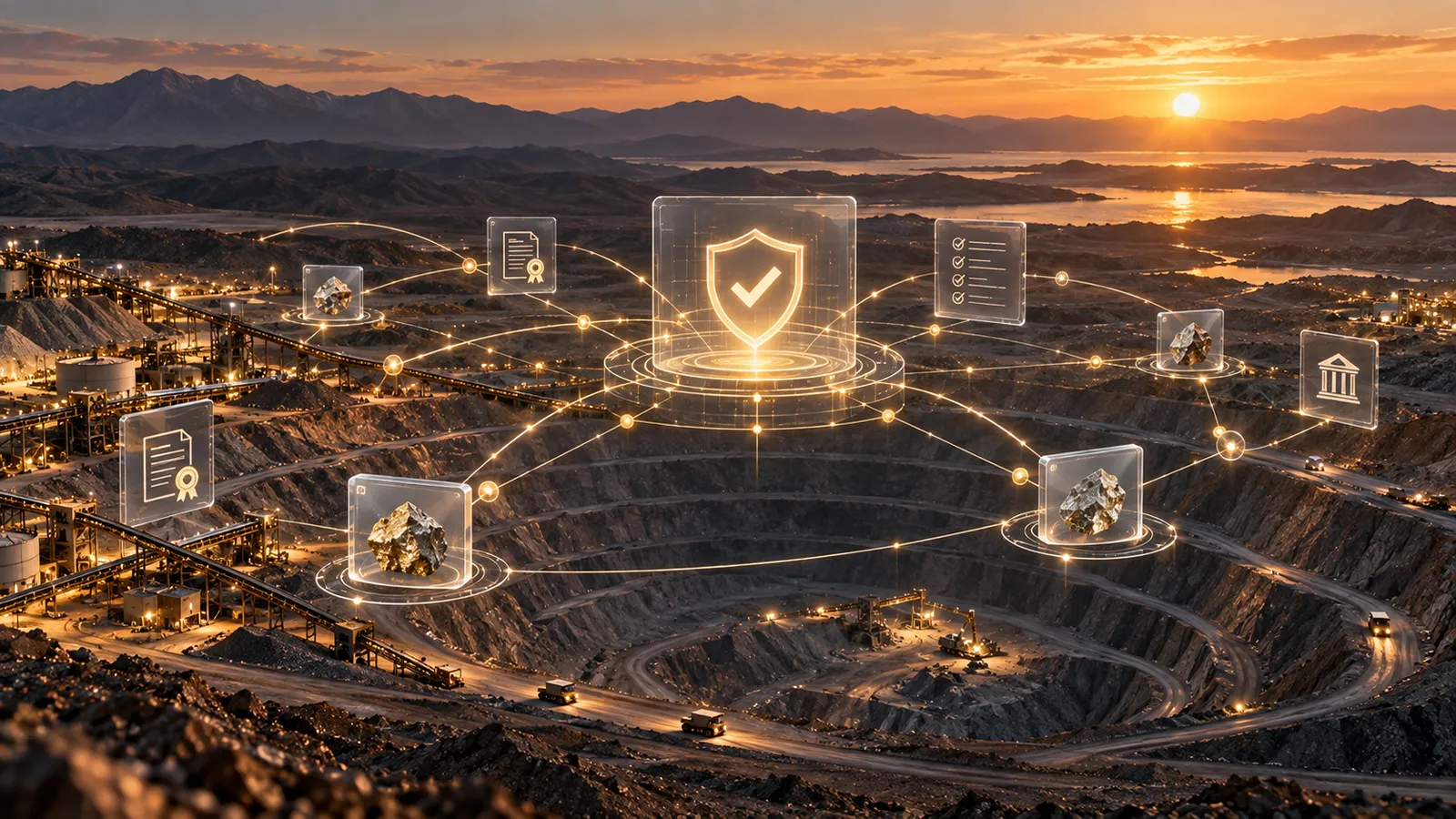
Start with the royalty, not the token
To understand a Digital Fractionalised Royalty, it helps to start with the underlying asset.
A mining royalty is a contractual economic interest linked to a mineral project. Depending on its structure, it may entitle the royalty holder to a defined percentage of revenue, production or another agreed measure when the mine generates qualifying proceeds.
The royalty itself is not new.
What digital fractionalisation changes is how that interest can be represented and held.
From one royalty to multiple digital units
Traditionally, a royalty agreement might be owned by one company, fund or institutional investor.
Digital fractionalisation allows an interest in that royalty to be divided into smaller units.
Each unit represents a defined economic interest under the structure established for that royalty.
Think of it as taking one large economic interest and creating a digital register capable of tracking smaller participating interests.
The important point is that the digital unit is not intended to create value from nothing.
Its value and potential distributions remain dependent on the underlying royalty and ultimately on the performance of the associated mining project.
What does “digital” mean?
The ownership and transaction records associated with the fractionalised interest can be maintained using distributed-ledger infrastructure.
This enables digital units to be issued, recorded and transferred through a controlled platform.
Tokenisation is increasingly being used in financial markets to represent existing assets and rights digitally. Regulators such as the Securities Commission Malaysia describe a tokenised capital-market product as a digital representation of an existing product and its associated rights, while preserving the fundamental characteristics of the underlying product. Securities Commission Malaysia
In practical terms, digital infrastructure can support:
- ownership records;
- transaction histories;
- settlement;
- compliance controls;
- transfer restrictions; and
- distribution of payments.
What does “fractionalised” mean?
A traditional royalty transaction can involve a substantial capital commitment.
Fractionalisation divides that exposure into smaller units.
For example, rather than requiring a single participant to acquire an entire royalty interest, multiple eligible investors could hold units linked to that interest.
The exact legal rights, unit structure, eligibility requirements and distributions depend on the relevant offering and documentation.
This approach has already been tested in institutional tokenisation research. Under Project Acacia, a mining royalty proof of concept demonstrated digital fractionalisation and settlement of a mining royalty interest. LinkedIn
What stays the same?
Digital fractionalisation does not remove the underlying mining risks.
A royalty still depends on factors such as:
Project development
A development-stage mine may never reach production.
Production performance
Volumes can rise or fall over the life of a mine.
Commodity prices
Depending on the royalty structure, changes in commodity pricing can affect revenue.
Legal and title risk
The validity and enforceability of the underlying agreements remain fundamental.
Operational and jurisdictional factors
Permitting, infrastructure, technical performance and local regulation can affect the project.
The technology changes the market infrastructure around the asset — not the geological and commercial realities beneath it.
Why fractionalise a mining royalty?
There are potential benefits on both sides of the market.
For mining companies
Fractionalised royalty financing can provide another way to raise capital without issuing additional company shares.
Rather than negotiating solely with one large royalty buyer, a digital marketplace can potentially aggregate capital from multiple eligible participants.
For investors
Fractionalisation can lower the size of the individual investment required to gain exposure to a royalty.
It can also make portfolio construction easier by allowing investors to spread capital across different commodities, projects or stages rather than concentrating it in one large transaction.
For the market
Digital ownership records and marketplace infrastructure can potentially make transfers and administration more efficient.
The RBA’s Project Acacia identified broader investor participation, transparency and shared transaction records among the potential benefits of tokenised market infrastructure. Reserve Bank of Australia
Where liquidity enters the picture
Traditional private royalties can be difficult to sell.
Finding a buyer, negotiating documentation and transferring the interest may require a bespoke transaction.
Digital units can instead be designed for transfer through a secondary marketplace between eligible participants, subject to regulatory, platform and asset-specific restrictions.
That does not guarantee liquidity.
A marketplace still requires willing buyers and sellers.
But it creates infrastructure through which secondary transfers can occur more efficiently than a purely bilateral private transaction.
How Monark approaches Digital Fractionalised Royalties
Monark’s model begins with the real-world royalty.
The asset and supporting documentation are reviewed before the royalty interest is represented digitally.
From there, the process is designed around four stages:
01 — Vetting and verification
The underlying project, documentation and counterparties are reviewed.
02 — Digital representation
The royalty agreement is structured and represented within the digital platform.
03 — Fractionalisation and issuance
The relevant interest is divided into digital units available to eligible participants.
04 — Trading and distributions
Units can be transferred through the marketplace where permitted, while royalty proceeds can be distributed according to the relevant ownership records.
This mirrors the four-stage lifecycle already described on Monark’s live How It Works page.
Real assets. Digital infrastructure.
A Digital Fractionalised Royalty is ultimately not about turning mining into cryptocurrency.
It is about applying modern market infrastructure to an established real-world financing instrument.
The mining project remains real.
The royalty agreement remains real.
The economic exposure remains tied to the underlying asset.
The digital layer is there to make those rights easier to divide, record, administer and — where a market exists — transfer.
That is what makes digital fractionalisation relevant: the asset does not become digital; access to it does.